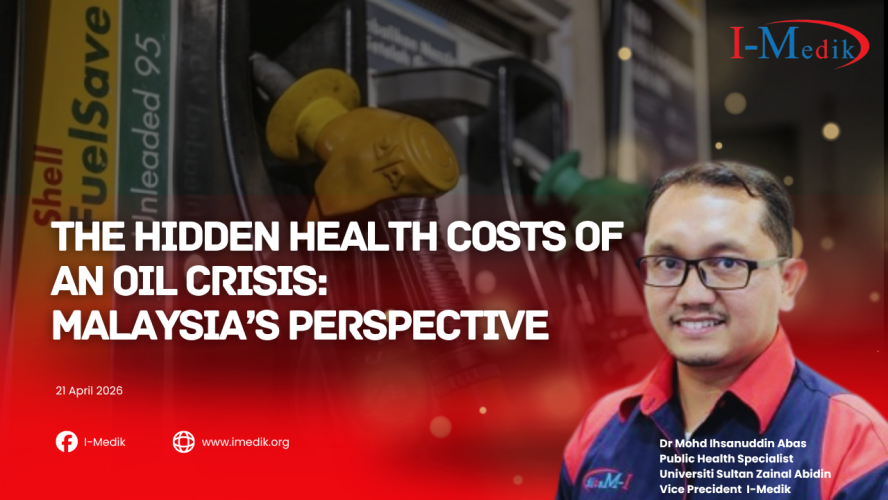
We have just recovered from the health-economic crisis during Pandemic COVID-19 in 2020, and now we are facing new war driven economic crisis that may affecting a lot of things that we never know before.
Have we learnt from the pandemic and preparing ourselves for crises in the future? Or we are repeating the same mistakes of missjudgement and malpreparation?
When oil prices spike or supply chains break, we think petrol stations and inflation. But in Malaysia, the ripple hits hospitals, pharmacies, and dialysis centers too.
1. Medicine and device costs surge
Modern healthcare runs on petroleum. Plastics for IV bags, syringes, dialysers, and PPE are all petrochemical-based. Malaysia’s Minister of Health Datuk Seri Dr Dzulkefly Ahmad has mentioned that following the recent crisis, the cost of medicines will rise 30-40%, while medical devices in hospitals may jump to 50-100%. The spike comes from higher logistics, transportation, and oil prices directly affecting pharmaceutical production.
2. Dialysis care at risk
This is where it gets life-or-death. Malaysia has almost 60,000 dialysis patients, with 90% of them are depending on haemodialysis. Every treatment would need single-use plastic consumables: blood tubing sets, dialysers, sterile packs, connectors. These rely on naphtha, a petroleum derivative used to make PE, PP, and PS plastics.
Analysts has warned that if Hormuz supply routes were disrupted, naphtha flow would be affected. This may increase plastic resin prices hence production slows down and dialysis supplies tighten. For ESRD patients who need dialysis 3 times per week, delays are not an option — it becomes a matter of life and death. Malaysia already has one of the highest incidence rates of end-stage renal disease in Asia Pacific. Have we look at ways to prevent this from worsening?
3. ESRD already strains the system
Recent updates from Ministry of Health Malaysia, between 2010-2016, Malaysia’s public sector ESRD expenditure grew 94%, from MYR 572 million to MYR 1.12 billion. ESRD costs grew 11.89% annually vs 5.54% for total health expenditure, taking up 2.95-4.20% of public health spending. An oil crisis will add pressure to an already expensive chronic disease burden.
4. Household health budgets break first
Oil-driven inflation may hit household wallets. When treatment gets pricier, people may skip it. Globally, nearly 60% of people surveyed postponed or avoided medical care due to cost. In Malaysia, cancer patients show how this will play out: early-stage patients faced mean out of pocket money (OOP) of MYR 4,388.65, while late-stage hit MYR 5,691.70. At a 10% income threshold, 67.2% of households faced catastrophic health expenditure. For B1 income households, that was 75.1%. Oil shocks push more families into that zone.
As a conclusion, health sectors need to start planning for the impact of this crisis. An oil crisis is not just about RON95. It is a national health security as well. The petrochemical chain runs straight into hospitals and treatment centres. We need to start some mitigation plans now need to cover pharmaceutical supply chains, not just fuel subsidies.
Dr Mohd Ihsanuddin bin Abas
Public Health Specialist
Universiti Sultan Zainal Abidin
#PublicHealth
#HealthCrisis